Last post

My whole blog dedicated to the history of radio engineering was a great task in the English language. It was designed for one semester. And now this semester is coming to an end, most likely this is the last post that I will write on this blog.

Keeping the blog has given me a lot: my level of English has improved, I learned a lot about how this science developed, I learned a lot about people who made an invaluable contribution to the development of radio engineering. For example, I found out who develop all the same first radio or who design it first osciloscope. And you can also find out about this and many other friends by reading my blog.

I really enjoyed blogging and I’d continue to blog, but I’m not sure what this is what I want to do now.

Bye.

Тelegraphs have learned to write

Hello, reader. My last post was devoted to magnetic arrow telegraphs. But such telegraphs eventually lost their accuracy and were not suitable for use.

They were replaced by writing telegraphic devices. The first such telegraph was built by Moritz Herman Jacobi and he connected the office of the Russian emperor Nicholas 1 in Tsarskoye Selo with the building of the ministry. But the truly popular telegraph was the Morse machine. This device was simple to operate and very practical, Morse also invented for him his alphabet known all over the world and now. The principle of operation of the device Morse was based on the fact that when you press the lever, he left a mark on the paper thus drawing symbols.

The next breakthrough in the world of transmitting information at a distance was Popov’s radio, which I already told you about.

Sources: http://www.diagram.com.ua/info/engineering-and-technology/engineering-and-technology098.shtml https://habr.com/ru/company/megafon/blog/193538/

New generation of telegraphs

Hi, in the last post I told you about the first attempts of scientists to make a telegraph that were not very successful and did not receive recognition. Today we will talk about more successful patterns of telegraphs, which brought the development of telegraphs to a new level.

The action of telegraphs with magnetic arrows was based on the phenomenon of the influence of current on the magnetic needle. The first electromagnetic telegraph
design Russian scientist Pavel Lvovich Schilling in 1830. The device consisted of a keyboard with 16 keys and the receiving device contained 6 multipliers. By the end of the thirties, many modified Schilling devices appeared. In 1838, Karl August von Stengel built a telegraph line of 5,000 meters, the longest at that time.

Schilling telegraph

Magnetic arrow telegraphs have become more widespread than their predecessors due to their practicality and simplicity. In the future, this technology continued to develop, how? I will tell in the next post.

Sources: https://ru.wikipedia.org/wiki/Телеграф http://www.i-kiss.ru/rubrika/telegraf_istorija_telegrafa

First attempts


Hello everyone, today we will talk about the first attempts of humanity to use the phenomena of electricity and magnetism to transmit information.

The very first attempts belong to the 16th century, incredible, right? In the 16th century it was proposed to use magnetic influences to transmit information, but these try were proved not successful. Already in the 18th century, it was proposed to use static electricity, and according to this principle, in 1774, Georges Louis Lessage set up a telegraph. But such telegraphs could be applied only at short distances and therefore did not receive universal acceptance. At the beginning of the 19th century there were attempts to use the chemical properties of the current for telegraph communication, but they too turned into failure.

More successful attempts were with magnetic arrows which I will tell you next time.


Georges Louis Lessage

Sources: https://ru.wikipedia.org/wiki/Электрический_телеграф http://mirnovogo.ru/telegraf


«Main elements»

The main part of the components of radio circuits are based on semiconductor materials. And to learn more about the history of the diodes, transistors and other components, we need to learn about what they are based on. As a rule, such elements of the periodic system of chemical elements as silicon and germanium are used as semiconductors.

Silicon was first obtained in 1811 by Joseph Louis Gay-Lussac and Louis Thénard by passing silicon fluoride vapors over metallic potassium, but they did not understand that this was a new element, so they did not attach any significance to this.

Germanium: In 1870, Mendeleev, on the basis of the periodic law, predicted a still undiscovered element of the fourth group, calling it Ecasilicia, and described its basic properties. In 1886, the German chemist Clemens Winkler discovered this element by chemical analysis of the mineral arhyrodite.

Thus, new elements were subsequently discovered which gave impetus to the development of radio engineering and science in general.

Source:https://ru.wikipedia.org/wiki/Кремний https://ru.wikipedia.org/wiki/Кремний

«He snatched the lightning from heaven, and then the scepters from the tyrants.»

Hi, in this blog I talked a lot about electrical appliances, about the history of their appearance. But I have never talked about without these devices being useless, and this is electricity. We do not know anything about how to get acquainted with electricity.

In the mid-18th century, Benjamin Franklin conducted experiments on the study of electrification. His conclusions and the results of experiments were read in the Royal Society where they found a response and produced a resonance. Benjamin introduced such terms as: positive, negative, charge, discharge (to describe the Leyden jar *), and so on.
But even such a great person could not do everything easily and simply, in one of his letters he described how during the experiment he was not shocked by the current, these lines: “I’m never ready to repeat. Two glasses of glass jars containing the junction, I’ve taken a little bit of my own Arms & Body, by Wires with one hand, while the chain held together with the outsides of both Jars. ”

*Leyden jar — the first electric capacitor

Source: https://spectrum.ieee.org/tech-history/dawn-of-electronics/ben-franklins-iotheri-great-electrical-discovery-turkey-tenderization https://ru.wikipedia.org/wiki/Лейденская_банка https://ru.wikipedia.org/wiki/Электричество

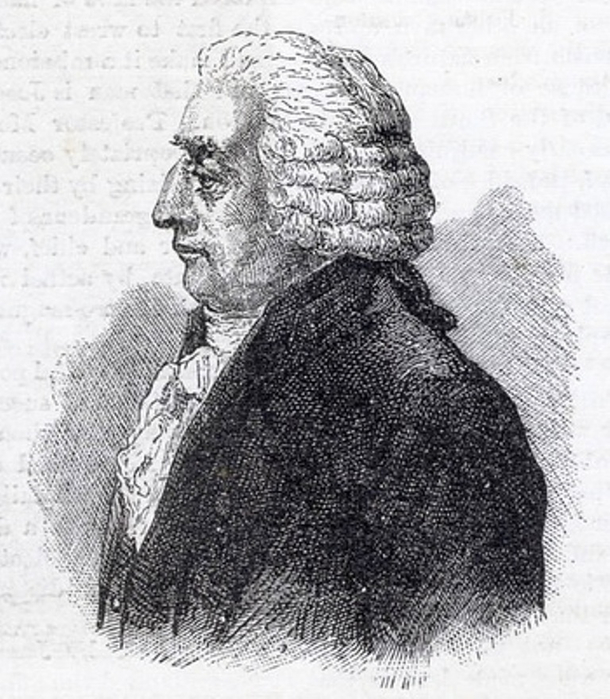
Jean-Baptiste Joseph Fourier

Radio engineering cannot be imagined without various mathematical functions. It is thanks to mathematics that we can correctly describe electromagnetic phenomena and make calculations.

Jean-Baptiste Joseph Fourier made a huge contribution to mathematics. Knowing the Fourier transform, we can calculate the power, amplitude of electrical signals and much more.

Jean-Baptiste was born March 21, 1768 in the city of Auxerre in France in the family of a tailor. Already from childhood, Fourier became interested in mathematics and was engaged in gathering candle ends at night. At the age of 17, he dreamed of a military career and wanted to become an artilleryman or military engineer. Despite the support of school teachers and inspectors, Fourier was refused due to his ignoble origin. During the French Revolution, Fourier returned to Auxerre and began to teach mathematics, rhetoric, history and philosophy at school, which he graduated from.

Jean-Baptiste Joseph Fourier is a great man, without his works we would not have been able to fully study electrical phenomena.

How do you like this format of articles? I think you are tired of stories about appliances and electrical components.

Sources:https://ru.wikipedia.org/wiki/Фурье,Жан-БатистЖозеф https://to-name.ru/biography/zhan-batist-zhozef-fure.htm

Oscilloscope

One of the most important inventions for the study of electrical oscillations is an oscilloscope. With the help of this device many new discoveries were made that would have been impossible without it.

Oscilloscope was invented by a French physicist André Blondel, who built and presented the first electromechanical oscilloscope back in 1893. This device was able to register values of electrical quantities, such as alternating current intensity. An ink pendulum attached to a coil recorded this information on a moving paper tape. First oscilloscopes used several mechanical devices in their work process, which made their measurements not very accurate and their bandwidth rather small, between 10 and 19 kHz.

Ondograph

Sources:https://www.masteram-labs.com/2016/09/blog-post.html https://ru.wikipedia.org/wiki/Осциллограф

Transistor

Hey, today we will talk about another semiconductor device that has been widely used in electronics

The Transistor was Invented in 1947 at Bell Telephone Laboratories
The invention of the transistor was an unprecedented development in the electronics industry. It marked the beginning of the current age in the electronics sector. After the transistor’s invention, advances in technology became more frequent, the most notable of which was computer technology. The three physicists who invented the transistor; William Shockley, John Bardeen, and Walter Brattain were awarded with the Nobel Prize. Considering the inventions that the transistor paved the way for, one could argue that it was the most important invention of the twentieth century.

Do you find it interesting that many devices have several inventors or are at all in dispute about their origin? What do you think about it?

Source:http://electrik.info/main/fakty/622-istoriya-tranzistorov.html

Diode

In essence, a diode is two semiconductors of different types of conductivity, a transition between them, which transmits electric current in one direction and not in the other.

John Ambrose Fleming (scientific adviser to the Marconi Company and former Edison employee) realized that the Edison effect could be used as a precision radio detector. Fleming patented the first true thermionic diode in Britain on November 16, 1904.
The principle of operation of crystal diodes was discovered in 1874 by the German
scientist Karl Ferdinand Braun. Braun patented the crystal rectifier in 1899.
Braun’s discovery was further developed by Jagdish Chandra Bose into a useful
device for radio detection.
The first actual radio receiver using a crystal diode was built by Greenleaf Whittier
Pickard. Pickard received a patent for a silicon crystal detector on November 20,
1906.

Sources:http://scsiexplorer.com.ua/index.php/istoria-otkritiy/1319-istorija-dioda.html